“Are you too deeply Occupied to say if my Verse is alive?” Emily Dickinson wrote with some fervor to the editor of a daily publication. “The Mind is so near itself—it cannot see, distinctly—and I have none to ask—”
Writing is best understood as a static text coming into contact with a dynamic mind. When this happens, real reading occurs. Though one may review their own text, they can’t exactly “read” it hoping to produce the same quality of experience that sparks when a stranger reads an unknown text. When this occurs, reading is like meeting a new person: sometimes boring, sometimes awkward, sometimes creepy, sometimes intriguing, sometimes euphoric.
Though you may try, one can’t well duplicate this experience on their own (though you can design your writing process to get the second best thing, as I explore in this post). You will find it hard to surprise, confuse, or shock yourself with your own writing since you already know what you are trying to say. Even if you do one day hope to write without the aid of a peer group, starting by forming one is a great way to create an internalized critic, one whose voice you can summon as you evaluate your work. This internal critic can be invaluable as you write to an audience, though it won’t perfectly imitate the vivacity of a peer group.
I present to you what I have deemed the “A Ghost in the Coffee Shop Peer Review Method.” It’s a mouthful, but it gets at the exact vibe of the method. This process was not created by me, but gleaned through my 9 years studying creative writing in higher education. This process is basically what I encountered in my creative writing classes, with some variations in each class. However, in my creative writing classes, this process was led by the instructor, asking questions to prompt responses from the students. This process has been adapted by myself to not need the instructor guiding the conversation. I’m sure this process has also been convergently developed in this way by the majority of writing groups out there with some small variations. Packaging the process like this hopefully makes it intelligible to those new to the peer review process. It certainly is not the default, which I’ve observed in the hundreds of students I’ve taught.
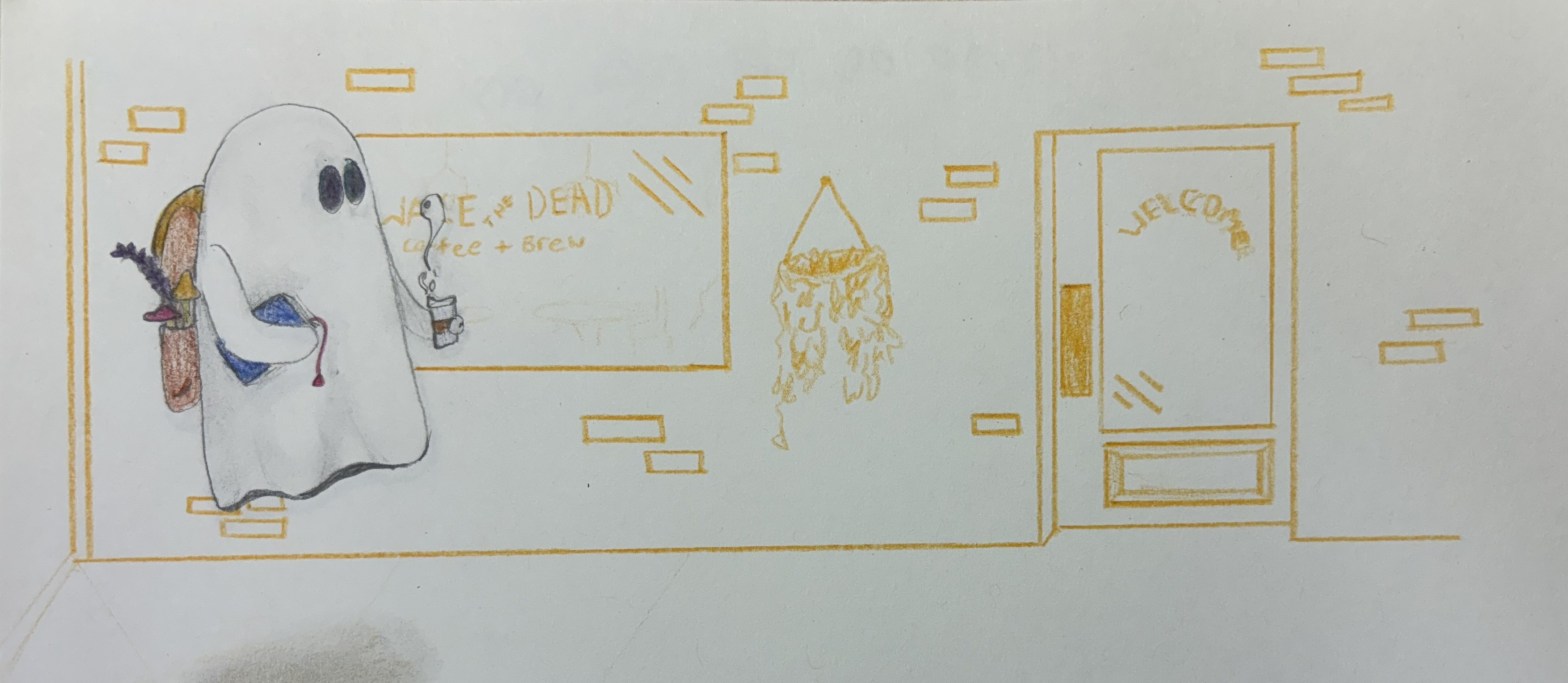
The process is this: The group of writers pretends that the author whose work is being reviewed isn’t actually there in the room. They ignore them completely, only making sure to speak loud enough for them to overhear what they are saying. The author is like a ghost who has wandered into a coffee shop, overhearing a group of writers who are discussing this lastest composition with alacrity. This ghost cannot provide any disclaimers or explanation for their text: the writing must speak for itself. The coterie is going into great detail on the draft: summarizing the piece, discussing what they love and what is working in the piece, discussing what they hate and what is at odds with its impact, etc. This isn’t an excercise in conformity either; each group member should honestly state their views on each aspect of the draft, especially if it conflicts with previously stated views. Each group member too should make sure each person speaks up. The value of this process is to get as many perspectives as possible on a draft. Each group member should be curious about what each other group member thinks about specific aspects of the draft.
At the end (or occasionally if a specific piece of feedback wasn’t quite heard) the ghost has a chance to ask a question about something left unaddressed. Perhaps the conclusion of the draft wasn’t spoken about. The ghost can thus reach into the living realm and convey a question, like, “Did my metaphor about the bicycle make sense? Was it effective or should I try another comparison?” After communing with the ghost, the coterie concludes, finishing off their coffees and leaving the shop.
This method streamlines feedback and prioritizes readers’ perspectives all while giving just enough room for the author to get additional information they may need. It can be much easier to give brutal, yet necessary feedback when you are not talking directly to the recipient. This is one reason why gossip persists, and why it is so much fun. I will enumerate the steps beneath for easy reference. If you are a writer or artist of any sort, how do you do peer review?
“A Ghost in the Coffee Shop Peer Review Method”
- The Author is silent, a quiet, invisible Ghost eavesdropping on a conversation.
- The Readers do not talk directly to the Ghost—whom they cannot see—only to each other.
- The Readers summarize the piece, its main themes, theses, or topics. Each Reader shares their view, often disagreeing with each other.
- The Readers talk about things they love, that are working in the piece, things that must stay should the piece be revised. Each Reader shares their view, often disagreeing with each other.
- The Readers talk about things they hate, things that are negatively affecting the impact of the piece, things that simply must go. Each Reader shares their view, often disagreeing with each other.
- The Ghost may ask questions of the Readers, probably about something they didn’t cover during their conversation.

 Over/Poetry