I am going to make a false comparison because I can.
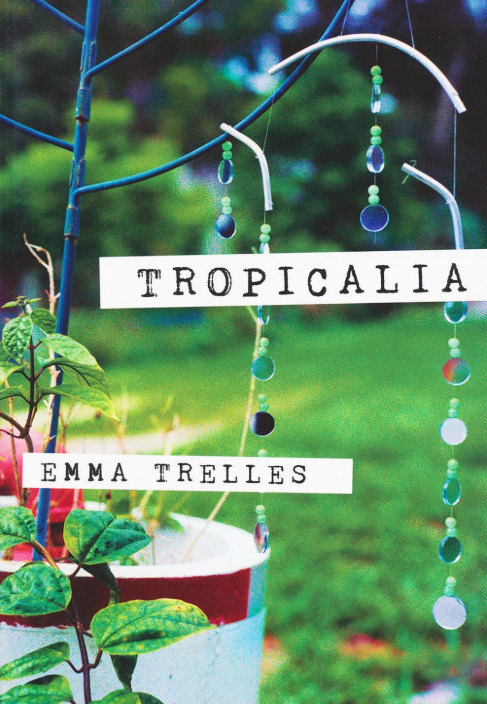
I recently read Tropicalia, Emma Trelles’ 2010 poetry collection. I also recently read some of Louise Glück’s poetry, not from any one period, but a generalized smattering.
Are these two poets vastly different with very different goals and audiences? Yes. Am I going to force a comparison between them anyway? Yes. Yes, I am.
I will be the first to acknowledge that not every poem in Tropicalia is great. Some are merely interesting or decent. But they are alive. They are juicy. They feel steeped in Floridian humidity and steamy and scorched. Are they particularly groundbreaking? No. But they are alive.
By “alive,” I mean textured. I like detail. I like big, fat vowels. In “Interstate Song,” the speaker notes that she wants to “write sky pearls and see those two words / beaded together, what the great poet saw / when he looked up and traced / a chain of white buckets, a fit of summer / clouds glazing light and light glazing / the gutter puddles”. (The “poet” referenced is W. S. Merwin, whose work I have never read but will now read.) The indulgent “u” in “gutter puddles,” the winking fun of “a fit of summer” are vibrant. Again, not groundbreaking artistically. But they are sumptuous, and I like that.
But “aliveness” in poetry refers not only to texture and vowel sounds, but also worldview. Tropicalia is fun. (Isn’t it strange that in the contemporary poetry universe, “fun” feels pejorative? Like I am accusing the collection of triteness? I’m not. I’m just saying, the collection feels . . . fun.) “Florida Poem” compares the oppressive heat to “ a devil / girl with oven-red lips / who wants your brains puddled / in a brass-capped mason jar.” In “If This Were a Restaurant Review,” the speaker “[sits] at the Kiev and ate a cold bowl of blood. It / [is] good” and is reminded of “Robert De Niro in Taxi Driver, not the part / where he’s burning / the tendons in his forearm over a gas stove, or when he takes / his date to a porn palace, / but the ending, when he drives off in his checkered chariot”. Is this description revolutionary? No. But it’s evocative, energetic, and above all alive.
I could criticize Tropicalia for its directionlessness. The collection doesn’t really go anywhere and each individual poem lacks a clear denouement. It’s a maximalist collection, evoking a sensory buffet, all-you-can-eat. And I love a buffet. My palate isn’t suited for meals with different courses. I like everything all at once.
Of course, the very nature of poetry renders a poem, to some degree, a product of constraint. The line breaks, the formal limitations, the need for certain sounds in certain places, constrict a poem’s possibilities, but paradoxically produce a series of surprising connections, enabled by the constraints. If a poet weren’t trying to find a description that fit within the syllabic limitations, that echoed the previous line, would they stumble upon the surprising description that they ultimately use? Maybe not. Poetry is a belief that limitation and discipline produces good results. I share this belief.
BUT limitation can become sterile if it’s unmarried to a, by its nature, optimistic eagerness for those unexpected connections. When a poem feels too planned (again, all poems are planned but they can’t feel too planned), the connections become overly strategic and symptomatic of a distrust in the magic of poetry. Poetry has to be just lax enough to enable some bizarre elements, some mismatches that spark off each other and evoke in the reader some previously unfelt response.
In comparison to Tropicalia, many of Louise Glück’s poems feel overly planned. Each image, each syllable is precise, perfectly aligned, executed thoughtfully. She has a direction, and her readers are funneled to each inevitable conclusion. Where’s the fun in that?
I am being obtuse, of course. Glück is brilliant. I have not read enough of her work to thoughtfully critique it and the poems of hers which I have read are interesting. But . . . I wouldn’t call them juicy. I wouldn’t call them a sensory buffet. I would call them thoughtful, philosophical, strategic. There’s not much lust in them and the life in them feels constrained. Again, all poetry must be constrained to be poetry. But can it go too far?
TLDR; Tropicalia is fun. And I mean that not in a trite way, but in a sincere, hungry, I-need-poetry-to-feed-me way. Give me directionless, sensory evocations of swampland! I need it.
That is all.

 Over/Poetry