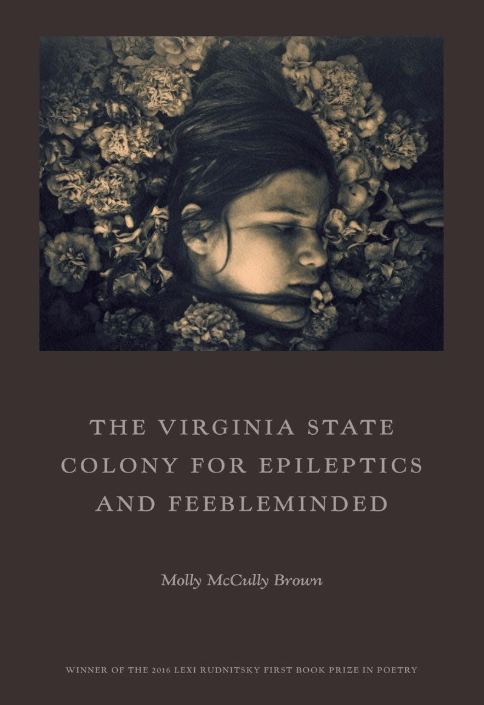
Review: Molly McCully Brown’s The Virginia State Colony for Epileptics and Feebleminded is a woman’s book—would men like it as much?
Poetry teachers across the land say and have said, for generations, that a good poet can make a good poem out of anything—content does not necessarily make or break a poem.
But some subject matter just demands poetry, and the subject matter of The Virginia State Colony for Epileptics and Feebleminded is such. It’s about the suffering inflicted on inhabitants of the titular institution, and it’s a graceful, restrained, radical consideration of what joy those inhabitants might have snatched from existence.
I don’t want to fall into the trap of chronological snobbery in this review or to perpetuate in any way the idea that people living in the past were all bigoted idiots who didn’t understand disability and shunted their different offspring in the direction of institutions. I’m sure there were just as many loving, supportive families in the past as there are now. That being said, there’s no escaping the unfortunate historical reality that there was an institution after which this book is named, and in it, as the author writes in the preface: so-called medical professionals “began sterilizing, without their consent, patients . . . deemed ‘defectives.’” The poems describe a grim existence in a Colony that was a real place, in which real people suffered.
Those people happened to be women. Well, “happened to be” may be a misphrasing. Whether there were historical realities that made women more likely than men to be institutionalized for disability is beyond the scope of this review, let alone my meager understanding. In some ways, cruelty knows no gender. But make no mistake: this is a woman’s book. I would be surprised if a man liked it as much as I, a woman, did. I could be wrong, and if I am, please tell me.
But the female reader is set up to empathize from the first poem, told from the perspective of a female speaker who is seeing the Colony through a car window and thinking that she, herself “Spastic, palsied and off-balance,” has avoided, through “some window less than half a century wide” a fate similar to the inhabitants of the Colony. It is, the speaker notes in the last lines of the first poem, what happened in “my backyard but not what happened / to my body—” As a woman on a regiment of SSRIs, that line struck a little too close to home. I’m not pretending to be disabled in the manner of the collection’s speakers. But any thought of having once, in a different world and time, maybe been considered too much to handle prompts thoughts in me like this speaker’s: what would have happened to me, even fifty years earlier, without the benefit of modern medication? I don’t want to know the answer.
The poems proceed, with several from the perspective of the Colony’s inhabitants, others in an Interlude, I assume, from the first speaker’s point of view. There are other points of view interspersed as well. This is my main critique of the collection—the perspectives of the various speakers are shifted between rather too unclearly. But that criticism is far, far outweighed by the collection’s accomplishments. A less thoughtful poet would have painted the Colony’s inhabitants’ sufferings sloppily, with great maudlin strokes and buckets of righteous anger toward a people that doesn’t protect the human beings it callously devalues. But Brown is a good poet, and so she creates a world that is elegant and restrained. These speakers are not just victims. They’re human beings with observations about their world, hidden knowledge about suffering and God. To walk that fine, fine gray line between respecting the sufferer without romanticizing in any way their pain, to acknowledge the horror of their mistreatment, the brutality of the beatings and medical abuse, without diminishing the humanity that enabled them to appreciate, at times, the strange beauty of their existence—Brown accomplishes what I would have thought impossible.
Poems like “What You’re After,” which I read from the perspective of a man who abuses the “imbeciles” down “in the blackness” calmly consider the reality of such abuse without avoiding its implications. And “Labor” notes that the Colony’s inhabitants were put to work while others, “twisted and mewling” are denied even the sliver of pleasure afforded from being allowed to leave the institution, living lives completely within the confines of the dormitory. The speaker is one of the latter and says that “I am one long echo of somebody else’s life.” How many invalids could say the same? Or how many inhabitants of nursing homes? It makes for painful reading when I consider how applicable that line is to so many alive today.
Of course, not every poem accomplishes what it should. “While Under” is disjointed. “New Knowledge for the Dark” feels thematically repetitive. The trick is to represent the monotony of suffering in such a way that each poem captures a different facet of it. Not every poem in the collection does.
But most do, and they do it so well that I almost can’t believe how effective it is. The inclusion of facsimiles of sterilization forms, which could easily feel too horrifying to elicit sensitive emotion, are instead unexpected poems themselves, in which medical language masks the cruelty of what is being done inside them, to them by people with appalling motives. And then, move of moves, the final poem in the collection, does yet another seemingly impossible thing: it elevates the speakers’ suffering to a place of martyrdom without in any way attempting easy answers or excusing or romanticizing. The image of “visions [that] have alit / like luna moths / around the dormitory” is beautiful, as is the simplicity of the final line: “this is what no one tells you about suffering / sometimes you would not give it up for all the world.”
The collection makes it easy for the reader. By easy I don’t mean that the subject matter is simple or comfortable or that contemplating such suffering shouldn’t make readers writhe. Rather, the collection feels effortless in the way that good poetry can make even the most heinous of things into art. Not reductive, not avoidant, nor exploitative—but agonizing and beautiful at the same time.
I don’t know if men would find this collection as good as I did. It is, for me, that uncomfortable connection between institutionalized speaker and self that strengthens the collection’s appeal. But again, I could be wrong. Maybe men will find as much to love in its sophisticated presentation of the human capacity for poetry amid horror as I did.

 Over/Poetry