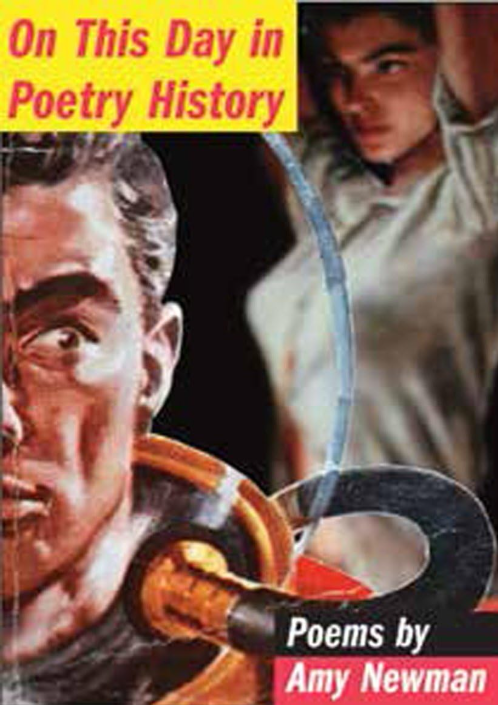
Some poetry collections are written with me in mind, I’m convinced.
I couldn’t imagine a poetry collection more well-suited than Amy Newman’s On This Day in Poetry History to my personal tastes. (Well, maybe one that talked extensively about Lord Byron’s Venetian exploits or Mitt Romney’s imaginary, pizza-fueled demise . . . but that’s why I wrote those collections.)
Does Amy Newman’s On This Day in Poetry History consider the complex relationship of 20th century poetry and Sylvia Plath? Check. (“that intractable flower / that suffers from the human touch . . . And the unhoused green / she varies into, / each forward, astonished step.” (61))
Does it contemplate the messy love life of Robert Lowell and his mistreatment of Jean Stafford? Check.
Does it include allusions to 20th century Americana that are thoughtful and not merely kitsch? (Though I do love kitsch, hence my obsession with Lana Del Rey.) Check.
Does it fixate on Anne Sexton and Elizabeth Bishop? Check.
Does it have diction and images that are so crisp and perfect they inspire in me a deep, messy envy because I wish I had written them? Check. (See “After Robert Lowell Starves Himself . . .”)
Does it feed into the myth of poetry while also being great poetry? Check.
— cue slideshow projection as I extract a large pointer from my backpack and begin jabbing at images of twentieth century poets while my students look on, eyes glazing over—
This collection is a compilation of poems about: Elizabeth Bishop, Theodore Roethke, Randall Jarrell, Delmore Schwartz, Sylvia Plath, John Berryman, Robert Lowell, Philip Levine, Anne Sexton. There is a mention of Walt Whitman, too. But for those looking for contemplations of earlier twentieth century poets (such as Robert Frost, Archibald MacLeish, Edna St. Vincent Millay, Ezra Pound), look elsewhere. This collection doesn’t talk much about them. To be fair, it’s got plenty of material to work with just in considering the mid century poets listed above.
The collection is a tight spiral that grows tighter and tighter, even as the poets themselves fly away—literally, in some cases—on the wings of poesy, escaping responsibilities, escaping America, escaping themselves. Is this why imagery of birds resurfaces throughout the collection? Maybe.
The collection succeeds in part because it’s doing two things at once: contemplating poets that have become characters in the myth of American poetry and refusing to talk about their poems. This is not a compilation of elusive references to their obscure works. It’s a writer poking at American poetry with a stick.
For example, in its consideration of Sylvia Plath, the collection has to contend with the dual reality of Plath, who was a woman, yes, but she is today also an icon, a symbol. She’s been Marilyn Monroe-ified into a version of all depressive, neurotic, brilliant, misunderstood women of the writerly strain. I’m frankly shocked there aren’t more t-shirts featuring her face. Is this deification of her fair? Is this good? I don’t know. But it’s happened. But considering Plath, patron saint of American female poets, “bleeding after rough sex, / a scary red, the red of too much” which “like her, / is artful” does feel a little disillusioning, a little undermining of the myth. But then the poem reestablishes the myth, because it traces in Plath’s blood an arrow to bigger and bigger things, asking directly: “Did you see that coming, American poetry?” (29).
When the collection presents these characters, the speaker assumes they need no introduction. And for me, a poetry fiend of the lowest order, they don’t. (Well, except for Delmore Schwartz. I had no idea who he was before reading this collection.) The collection contextualizes the characters/poets, but it doesn’t introduce them. The whole collection banks on our familiarity with them. Then the collection presents these characters again and again, contrasting them, showing them in different situations, different contexts, until at last it becomes clear we cannot escape them: the spiral tightens into a line, a thin line, between humanizing these poets by showing them in the midst of their human lives and deifying them, by making clear the importance of their actions, like John Berryman, “during his admission procedure at Abbott Hospital’s mental health unit,” discoursing on The Scarlet Letter, on women’s hearts, “all language on the inside” (56). The significance of John Berryman’s writing, his contributions to art and literature, add luster to the strangeness of the subject, but to be clear, it would be an interesting subject regardless. But not quite as interesting.
The significance of the characters elevates the book, without feeling indulgent. Well, okay, maybe it’s a little indulgent when it devotes yet another poem to Robert Lowell, the last about his travel arrangements. But I read it, because Robert Lowell was a great poet, and a weird, messy, dangerous, very flawed man. Even him sitting still in an airplane is interesting. Do I need to relearn this because it soothes something inside me, to know that great poets are flawed, sometimes self-destructive? Or am I retelling myself the myth of poetry, again, to reassure myself of my place in it, of the importance of my scribblings, which most of the world, let’s face it, couldn’t care less about?
There is something rebellious about this book. It assumes the reader’s interest in the subjects. It never tries to be all that accessible to the new poetry fan. It invites the reader to share its fixation on the characters, but that’s all the concession it makes to poetry naysayers. I can imagine some readers turning down the invitation, due to unfamiliarity with the characters or disinterest in the time period. But as for me? I accepted. This book is a poetry lover’s dream.


