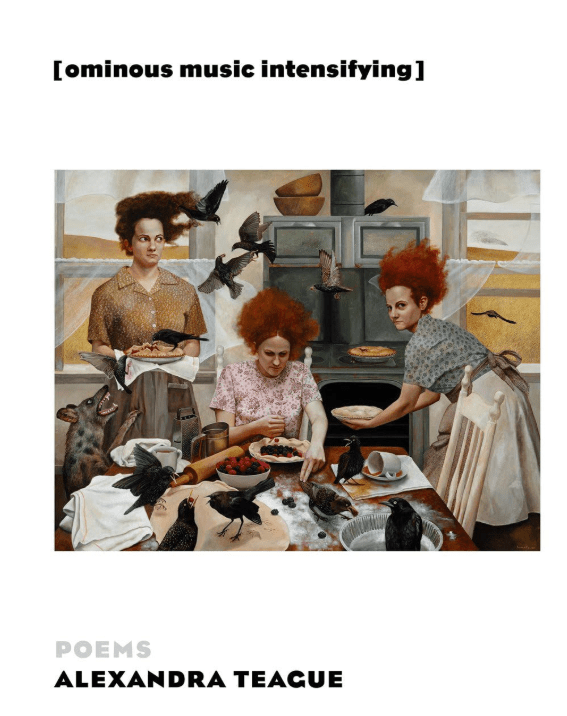
To be fair, the cover art is called The Visitors by Andrea Kowch which Steve Parks of Newsday described as “Using Middle America . . . [to draw] the history of a particular place— invariably rural—to the surface as it collides with a new reality in layers of metaphor and moodiness. The faces of her women may remind you of characters in a Tim Burton film.“ The three women are depicted in a kitchen, but this is an anti Norman Rockwell scene. The women’s hair stands on end, and they are visibly exhausted and overheated as they labor to produce food, but ultimately expressionless. They stare at the viewer, almost in accusation. The image is an undermining of Americana, specifically midcentury Americana. And yet . . .
The book’s take on America feels retro not because it’s deliberately comparing and contrasting midcentury America with contemporary America. It feels retro because even since the book’s publication (just one year ago), the political world has changed so drastically, I find it hard to focus at times on the poems’ stated questions.
For example—
In the poem “Sad Clown Paintings,” which has a very fun opening line—“A painter friend has developed a theory: / everything is a sad clown painting, but only sad clown / paintings know this”—the list of environmental disasters gets interrupted by my internal chortle at the line “we should all call our senators / about the EPA/everything.” Yes, we should, but now just to make sure the organization still exists at all.
Similarly, in “Crossed Letters from a Concerned American,” the speaker addresses Republican Senator Mitch McConnell, saying “this country is bigger / than we’re making it” and “we need more dimensions / to understand each other.” The idea of a poem that mimics a crosshatched letter (Google that one) is interesting, but the publisher didn’t actually crosshatch the poem, which feels like a letdown. And is Mitch McConnell really the biggest threat to Americans lurking in Congress these days? I would argue not. Again, that’s not the poet’s fault. No one could have predicted exactly how much would change between the publication of this collection in 2024 and my reading it one year later. But it does feel strange to me to spend so much space on McConnell who, compared to the recent influx of Trumpies, seems relatively sane. Of course, the question of McConnell’s ideology could be applicable to many politicians across many years. I’m sure he’s not the only Senator America has ever had or will ever have who, according to Teague, lacks the imaginative sympathy necessary to really grasp the grandeur of “this country” which is “big / enough for contradictions.”
Other poems fare better. “Rough Beast Would Like the Future To Be Clear,” a reference to Yeats’ “The Second Coming,” itemizes “nose bleeds / from the first few weeks of antidepressants, a dark joke / turned inside out. A bad surprise party” and “an egg that is / sizzling in that 1980s anti-drug ad.” In this poem, I like the items in the list. They are interesting, arresting. I just wish I knew better why I was made to read them. The poem concludes that “so much depends on / feeling as if something depends on us.” Is this profound? I don’t know.
The entirety of the collection is like watching a speaker sift through an American landfill, which is engaging. (The first poem in the collection is about a thrift store.) Maybe treasures will be found. But I crave some stronger connection between the items and the speaker, beyond a fragmentary sense of the trash indicating something about America. What is that something? The speaker never seems confident in an answer.
In “The Years I Lived Beneath the Lake,” the speaker asks, “What did I want? Stillness and a handwritten price, / though I never bought anything; / poor and scared of my life / rubbing off on them: these objects that existed / perfectly without me.” The final line is strong—“No one living wore such pleated skirts.” The collection evokes, perhaps is meant to evoke, a sense of drowning in America’s legion of crap, America’s material hoarding, America’s historical weight, America’s ideological detritus. This sensation is interesting, memorable, intriguing. But is it enough?
Not for me.

 Over/Poetry